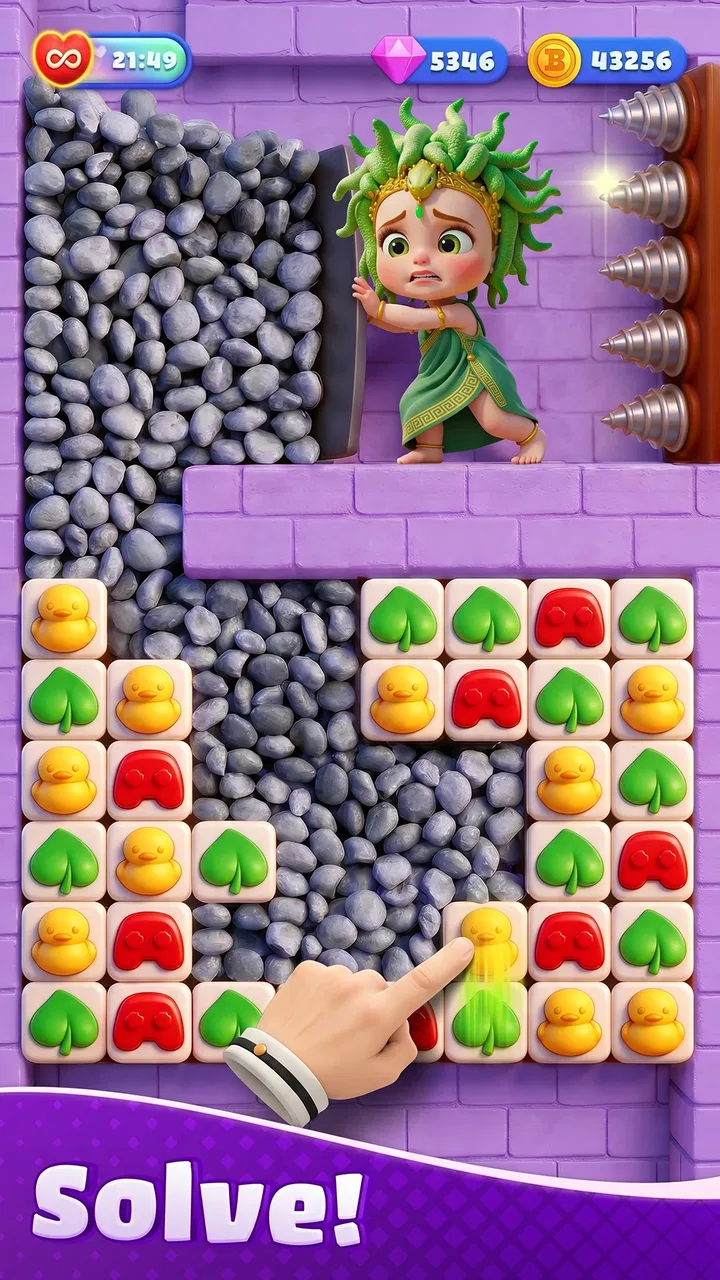
Babytopia: Match 3 Puzzle Game
- 4.7
- Rating
- 500.00K
- Installs
- Free
- Price

 Analysis by App-foxy
Babytopia: Match 3 Puzzle Game caught my attention because it keeps the familiar match-three idea at the center while presenting it as a light, approachable casual game. I spent time with it as the sort of title I would open between errands, during a short break, or when I wanted something easy to understand without committing to a long session. My overall impression is positive, but it depends heavily on what you want from a puzzle game: this is better suited to relaxed, bite-sized play than to players searching for a deep competitive system.
What makes it easy to recommend is the low barrier to entry. The basic objective is immediately readable, the presentation is friendly, and the game does not ask you to learn a complicated control scheme. At the same time, match-three games can become repetitive when every level feels interchangeable. Babytopia works best when you treat it as a small daily diversion rather than a demanding strategy experience.
The match-three capability that shapes the whole experience
The defining capability here is the match-three puzzle format itself: arranging similar pieces so they disappear and make room for new ones. That sounds familiar, and it is, but familiarity is part of the appeal. I could pick up the game without a tutorial-heavy introduction, make a few moves, and understand the rhythm almost immediately. For a casual game, that quick start matters more than an elaborate opening sequence.
You May Also Like

 Blood Strike: 2.5 Anniversary
Blood Strike’s Loadouts Turn Every Drop Into a Tactical Gamble
A close look at Blood Strike’s custom loadouts: how fast access to signature weapons reshapes its battle royale rhythm, rewards preparation, and narrows the gap between fights.

 Pandora - Music & Podcasts
Pandora’s Music Is Easy to Start, but Harder to Recover
Pandora’s strength is its low-effort path from a seed to a station. Its weak spot is how much confidence it asks you to place in connection, setup, and quiet recovery.

 8 Ball Pool
 Is Built on Rivalries, Rematches, and Routine
A close look at the rivalries, rematches, shared routines, and unanswered safety questions that turn a quick pool match into a persistent mobile community.

 Samsung Music
’s Quiet Strength Is Playing What You Already Own
Its reach comes less from spectacle than from dependable access to a personal library. That simplicity is both the app’s strongest retention engine and its ceiling.

 AccuWeather: Weather Radar
AccuWeather Review: A Quick, Clear Forecast for Everyday Decisions
For everyday plans, the best forecast is the one you can understand quickly. AccuWeather makes rain timing, radar, and local conditions easy to act on, with a few trade-offs.

 Hill Climb Racing
Why Hill Climb Racing Still Turns Crashes Into One More Run
A tiny car, a bumpy hill and one more upgrade: Hill Climb Racing keeps resurfacing because its simple chaos makes every near-miss feel personal.
More From Our News Desk
View All News


The “surprises” suggested by the game’s presentation are most effective when they interrupt that basic rhythm. A match-three board is naturally repetitive, so unexpected changes in a level can make me rethink an otherwise automatic move. I found that the best way to enjoy Babytopia was not to rush every available match. Taking a moment to inspect the board usually produced better choices than simply tapping the first obvious combination.
This is also where the game’s audience becomes clear. Babytopia is rated for Everyone, and its tone feels suitable for players who want a gentle puzzle rather than something intense or intimidating. I would be comfortable suggesting it to a family member who enjoys simple mobile games, although younger players may still need guidance around optional purchases. The game is free to start, which makes trying it straightforward, while in-app items range from $0.99 to $99.99 each, so purchase awareness is important on a shared device.
In my experience, the main strength of this format is flexibility. A single board can fill a few spare minutes, but the same basic activity can also become a longer session if I am in the mood to keep going. That makes it more practical than many games that require a fixed block of time. I can stop after one puzzle without feeling that I have abandoned a complex storyline or left teammates waiting.
How the board works in practice
The useful skill is not simply finding any three matching pieces. The better habit is to look for moves that create space, set up a second match, or change the lower part of the board in a helpful way. I started by scanning from the bottom upward, because clearing lower pieces can affect what falls into the spaces above. Even when the game is designed for casual play, this small change in perspective makes the puzzles feel less random.
Another practical tip is to avoid spending every helpful move immediately. If the board offers a modest match near the top and a more promising arrangement below, I prefer to examine the lower option first. A quick match may be satisfying, but it can also remove pieces that would have supported a stronger chain. This is the kind of small decision that gives Babytopia more texture than a purely automatic tapping game.
I also recommend using the first few seconds of a level as a planning period instead of treating them as wasted time. Look for areas that appear crowded, identify matches that open blocked spaces, and consider whether a move will leave the next turn better or worse. This approach is especially useful when a level introduces a layout that does not immediately respond to the usual left-to-right scanning habit.
The game’s casual identity does not mean every board will feel equally effortless. Some arrangements are naturally clearer than others, and an unlucky cascade can make a good plan less reliable. That unpredictability is part of the charm for players who enjoy surprises, but it may frustrate anyone who expects every outcome to be fully controlled. I see Babytopia as a balance between deliberate choices and the changing board produced after each match.
One of the less obvious benefits of this design is that it supports different attention levels. When I am tired, I can play by spotting obvious combinations and still get a pleasant break. When I am more alert, I can search for sequences and preserve better positions. That range is valuable in a phone game because I do not always open it with the same amount of concentration.
A realistic everyday use case
My ideal scenario for Babytopia is a short waiting period: sitting in a clinic reception area, waiting for a train, or taking a quiet pause after finishing a task. I can open it, complete a few moves, and put the phone away without needing to remember a complicated control layout. If I have more time, I can continue, but the game does not depend on that longer commitment.
It also fits well into a low-pressure evening routine. After a busy day, I often do not want a competitive game that demands fast reactions or constant concentration. A match-three board gives me something to focus on without making the session feel like another obligation. The colorful, accessible style supports that use better than a darker or more serious puzzle title would.
For parents, the Everyone rating makes the game easier to consider for a family device, but I would still check purchase settings before handing over the phone. Free access is convenient, yet the presence of optional items at very different price points means the financial side should not be ignored. The safest approach is to treat the game as free to try, not as a promise that every part of the experience is cost-free.
I would not choose Babytopia as my first option for a long commute if I wanted a story, a large world to explore, or a strong sense of character progression. Its value comes from the board-by-board activity. For a quick distraction, that is a strength; for a broader gaming experience, it is a limitation.
Where it differs from the usual alternatives
Compared with a minimalist match-three game, Babytopia feels more welcoming and playful. A minimalist alternative may be preferable if you want a clean board, very little visual decoration, and a purely score-focused experience. Babytopia is the better fit for me when I want the puzzle to feel like part of a cheerful setting rather than an abstract exercise.
Compared with highly competitive puzzle games, it is less appealing for players who need rankings, timed pressure, or a serious multiplayer environment. I did not approach it as a test of reflexes or as a game to master for public recognition. Its appeal is personal and immediate: make a few good choices, enjoy the changes on the board, and move on.
It also differs from story-led mobile adventures because the match-three action remains the reason to return. If narrative is your main motivation, a story game will probably give you more emotional variety. If you prefer a repeatable puzzle loop that can be understood in seconds, Babytopia is more practical. The right choice depends less on which game is objectively better and more on whether you want a puzzle tool for spare moments or a complete entertainment package.
Tradeoffs that matter before installing
The first tradeoff is depth versus accessibility. The approachable rules make the game easy to start, but players who have spent years with match-three titles may eventually want more complex systems or a sharper difficulty curve. I enjoyed the simplicity in short sessions, yet I would not describe it as a replacement for a dedicated strategy puzzle game.
The second is free access versus optional spending. Being free makes Babytopia easy to test, and that is a meaningful advantage when you are unsure whether the style suits you. However, the available in-app purchase range is broad, from $0.99 to $99.99 per item. I would advise setting a device-level purchase safeguard, particularly if children use the same phone or tablet.
A third tradeoff is unpredictability. Cascades and changing board situations can create pleasant surprises, but they can also make a carefully planned turn feel less decisive. Players who enjoy adapting will probably see this as part of the fun. Players who want a puzzle with a single clearly optimal solution may prefer a logic title where randomness plays a smaller role.
There is also a question of long-term motivation. Casual match-three games are naturally repetitive, and Babytopia is not the right choice if you quickly lose interest without a substantial narrative or a competitive target. I suggest trying it in short sessions first. If the basic loop still feels enjoyable after several brief plays, it has a good chance of becoming a reliable time-filler. If the core matching action already feels familiar and flat, extra play is unlikely to change your opinion.
Device compatibility is reasonably broad: the game requires Android 8.0 or later. That makes it accessible on many older Android phones, although the exact feel will still depend on the device’s screen size and responsiveness. On a smaller display, I would pay closer attention before tapping because crowded boards can make neighboring pieces easier to confuse.
Elementa Games has kept the product focused enough that the current version, 6.8.0, feels like a straightforward casual title rather than an overloaded collection of unrelated activities. That focus is welcome, but it also means you should not install it expecting a different genre hidden behind the match-three label. What you see at the center of the experience is what you will spend most of your time doing.
Who gains the most from Babytopia
I think the strongest audience is people who want a friendly, low-commitment puzzle for small gaps in the day. It is especially suitable if you like games that explain themselves quickly and let you decide how long to play. The Everyone rating broadens its appeal, while the free starting price removes much of the risk involved in trying it.
It is also a good option for players who enjoy improving through small habits rather than studying elaborate mechanics. Scanning from the bottom, protecting useful arrangements, and delaying an obvious match are simple techniques, but they make a noticeable difference in how thoughtfully the board feels. Those habits give casual players something to practice without turning the game into homework.
I would be more cautious about recommending it to someone who dislikes in-app purchases, wants a completely distraction-free premium game, or expects a substantial story. The purchase range means families should manage spending carefully, and the repeatable puzzle loop may not satisfy players who need constant novelty. In those cases, a paid puzzle game with a fixed structure or a narrative adventure would likely be a better match.
The game has already attracted a substantial audience, with over 500,000 installs and an average rating of 4.7 from around 28,000 ratings. Those figures suggest that its accessible approach is connecting with many players, but they should not replace your own test of the central loop. Match-three preferences are personal: a design that feels relaxing to one person can feel repetitive to another.
After trying it, I would describe Babytopia as a dependable casual companion rather than a landmark puzzle game. Its best quality is the way it turns a familiar matching system into an easy-to-enter activity with enough board variation to reward attention. The practical advice is simple: start with short sessions, inspect the lower part of the board before moving, and protect your purchase settings if others use your device.
My recommendation is to try it if you want an approachable match-three break, not if you are looking for deep strategy or a story-driven adventure. The free entry point makes that decision easy, and the game’s gentle style suits everyday downtime. Just keep your expectations aligned with its casual purpose, and Babytopia can become a pleasant little routine rather than a game you expect to occupy every kind of gaming mood.
FAQs for Babytopia: Match 3 Puzzle Game
01What is Babytopia: Match 3 Puzzle Game?
Babytopia: Match 3 Puzzle Game is a casual puzzle experience built around classic match-three gameplay. You swap colorful pieces to create groups of three or more, complete level objectives, and progress through a playful world designed around baby-themed characters and decorations. The game is easy to understand, but later stages introduce more demanding layouts, obstacles, and limited moves that require planning.
02How do you play Babytopia, and is it suitable for beginners?
The basic controls are simple: tap or swipe to exchange neighboring pieces and form matching combinations. Completing larger matches can create special boosters that clear rows, columns, or groups of tiles, helping you overcome difficult boards. Babytopia is generally beginner-friendly because the early levels teach the mechanics gradually. However, the challenge increases over time, so careful move selection becomes more important than simply making the fastest match.
03Does Babytopia: Match 3 Puzzle Game require an internet connection?
Babytopia may allow some puzzle levels or basic features to work without a constant connection, which is convenient when traveling or playing in areas with weak reception. Nevertheless, online access can be necessary for advertisements, rewards, cloud synchronization, events, updates, purchases, or other connected features. Availability can also vary by device and version, so it is best to launch the game online at least once after installing it.
04Is Babytopia free to download, and does it include in-app purchases?
Babytopia is typically available as a free download, but free access does not necessarily mean that every feature is completely unlimited. Match-three games commonly include optional in-app purchases for extra lives, boosters, coins, or other resources, and advertisements may appear between levels or when claiming rewards. You can usually play without paying, although progress may feel slower unless you use the available bonuses carefully.
05Is Babytopia appropriate for children, and what should parents know?
The colorful presentation, simple controls, and relaxed puzzle format can make Babytopia appealing to children and families. Parents should still review the age rating, advertising behavior, privacy information, and purchase settings before allowing independent play. If the game offers boosters, premium currency, rewarded videos, or time-limited promotions, enabling parental controls and requiring authentication for purchases is a sensible way to prevent accidental spending.
Pros
- Simple match-3 mechanics are easy for children and casual players to learn.
- Bright visuals and cheerful themes make the game appealing to younger audiences.
- Short levels work well for quick play sessions on mobile devices.
- Progression through stages provides a clear sense of achievement.
- Offline play may be convenient when an internet connection is unavailable.
Cons
- Frequent ads can interrupt gameplay
- especially between completed levels.
- Some levels may rely heavily on boosters or extra moves to be completed.
- In-app purchases can make faster progress more tempting for children.
- The puzzle mechanics may feel repetitive after extended play sessions.
- Parental supervision is recommended because of child-focused monetization elements.

Babytopia: Match 3 Puzzle Game
Gallery